
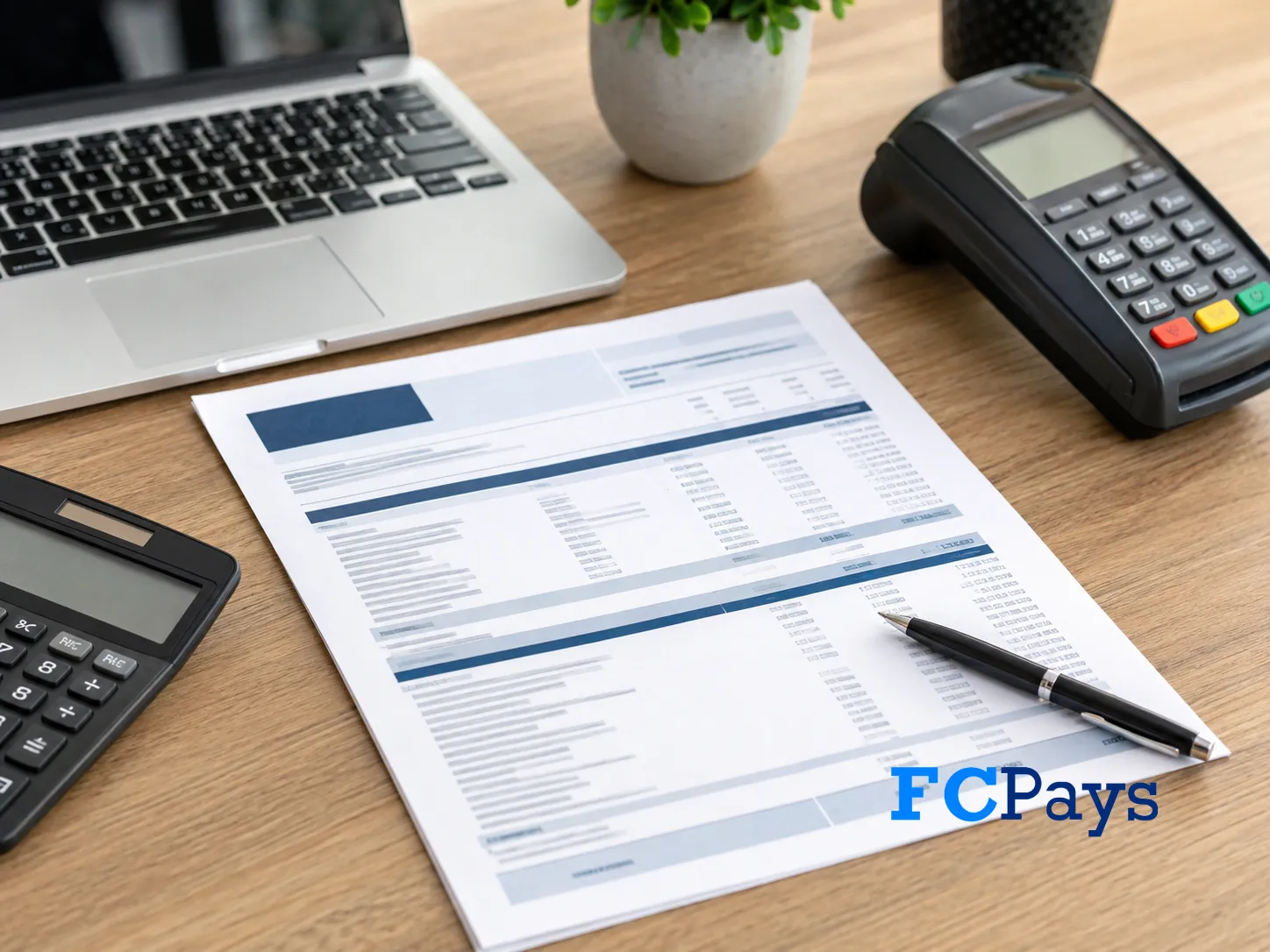
Quick answer
Knowing how to read a merchant statement starts with verifying the statement period and sales totals, matching deposits to your bank account, reviewing every fee, and calculating your effective rate. If you use a high-risk merchant account, also review reserves, chargebacks, and any account-monitoring charges that may affect your deposits.
What you should know before you start
What does a merchant account statement include?
- A monthly breakdown of the transactions processed, the fees charged, and the funds deposited to your bank account.
- Sales activity, refunds, chargebacks, reserves, and adjustments when they apply.
Where should you look for unexpected fees?
- In markup fees or account charges that do not match your agreement or a documented rate-change notice.
- In unclear line items such as statement fees, batch fees, and Payment Card Industry (PCI) noncompliance charges.
How often should you review your statement?
- Every month, using the same review method so changes stand out.
- Compare the current statement with your agreement and the previous two or three months.
Which charges may be negotiable?
- Card networks establish interchange schedules, so your processor can’t rewrite those for you.
- The processor markup fee and some provider-controlled fees may be negotiable, depending on the account.
Knowing how to read a merchant statement protects one of the largest costs in your business. The stakes rise even higher if you hold a high-risk merchant account, where reserves and monitoring can affect what lands in your bank account. A careful read helps you catch hidden fees, understand your true cost, spot rate increases early, and track cash flow and fraud. We put together this guide to explain what each section means, which costs may be negotiable, and what to question when a charge doesn’t match your agreement.
Source: Merchants Payments Coalition
Source: Merchants Payments Coalition
Table of contents
- What a merchant processing statement shows
- How to read a merchant statement step by step
- Which credit card processing fees appear on a statement
- How your pricing model changes your processing statement
- How card-not-present and third-party transactions affect costs
- How to read a merchant statement for hidden fees
- How to calculate your effective rate
- How to review chargebacks, refunds, and adjustments
What a merchant processing statement shows

A merchant processing statement, also called a credit card processing statement or merchant account statement, summarizes your card activity for a billing period. It works like a financial report for the transactions processed during the statement period, separate from your regular bank statement. The format varies by provider, but most statements include account information, your merchant number, an account summary showing processed volume, transaction counts, and other details relevant to your business operations, deposit or funding details, sales activity by card brand, a fee summary, and chargebacks, refunds, reserves, and adjustments when they apply.
The statement functions as more than a bill. It gives you an audit trail that connects gross card sales with the net funds deposited into your bank account. The Merchants Payments Coalition describes swipe fees as most merchants’ highest operating cost after labor and reports that U.S. merchants paid a record $198.25 billion in card processing fees in 2025, up 5.9% in a single year.
Good to Know: A merchant statement and a bank statement serve different purposes. The merchant statement explains the transactions and deductions behind each deposit, while the bank statement shows the amount that reached your account.
How to read a merchant statement step by step

Use the same review process for your monthly statements every time. A consistent method makes billing changes easier to spot and gives you cleaner records for accounting.
Step 1: Confirm the account information
Verify the business name, statement period, processor contact details, and merchant identification number (MID). Treat your MID and unredacted statements as sensitive business information, and ask your provider how to submit documents securely before sharing them with another party.
Step 2: Match deposits to your bank account
Compare the statement’s deposit totals with your bank account. Account for weekends, holidays, and the provider’s funding schedule before treating a timing difference as an error. If amounts still don’t match, look for reserves, chargebacks, refunds, or fees deducted before funding, and ask the provider to explain any unresolved differences in writing.
Step 3: Review sales activity and transaction data
Check gross sales, transaction count, average ticket, and activity by card brand. A change in card mix, such as a rising share of corporate cards relative to debit cards, can change costs even when your contracted markup fee stays the same.
Step 4: Identify your pricing model
Your agreement should state whether you have flat-rate, interchange-plus, tiered, or subscription pricing. Confirm that the statement follows that pricing structure and that the markup fee matches the agreement.
Step 5: Review every fee
Trace each fee to your agreement or a documented rate-change notice. Flag unclear abbreviations, new monthly fees, or a fee that continued after you completed the required action. Our guide to MTOT DISC merchant account fees explains one common bank-statement descriptor many business owners don’t recognize. We walk clients through this exact line-by-line process during a statement review, and it’s usually where the biggest surprises turn up.
Step 6: Check chargebacks, refunds, reserves, and adjustments
Confirm that each amount matches your transaction and dispute records, with no incorrect transaction amounts slipping through. Review the transaction date, reason code, and case status when those details are available.
Step 7: Calculate and compare your effective rate
Calculate your effective rate using the same categories every month, then compare fees month to month and against your agreement. A change gives you a reason to investigate, but it doesn’t automatically prove you were overcharged.
Monthly statement review checklist
- ✓ Account details and statement period verified.
- ✓ Deposits reconciled with the bank account.
- ✓ Pricing model confirmed.
- ✓ Every fee matched to an agreement or notice.
- ✓ Chargebacks, refunds, reserves, and adjustments reviewed.
- ✓ Effective rate calculated consistently.
Which credit card processing fees appear on a statement

The total cost to accept payments can include card-network costs, the payment processor’s markup, and fixed account charges. The names vary by provider, so focus on who receives the fee and what your agreement says.
Interchange fees and card-network costs
Interchange makes up one component of card acceptance pricing, and it flows to card-issuing banks rather than to your processor. Visa explains that interchange reimbursement fees operate between acquiring and issuing banks, while merchants negotiate and pay a merchant discount to their financial institution that may cover a variety of processing services. Mastercard similarly states that it establishes its interchange rates while having no involvement in acquirer and merchant pricing agreements. Card networks also collect assessment fees on card transactions, a smaller network-level charge separate from interchange.
You generally can’t ask a payment processor to change a card network’s published interchange schedule, but you can review the processor markup fee and other provider-controlled charges. The Merchants Payments Coalition reports that the average Visa and Mastercard credit-card swipe-fee rate reached 2.36% in 2025, although individual merchant costs vary by card type, sales channel, and agreement.
Payment processor charges and account fees
Other statement charges may include processor markup, gateway costs, equipment fees, and provider-controlled account charges, such as transaction fees, monthly service fees, batch or settlement fees, authorization fees, equipment rental charges, and chargeback or retrieval fees. Don’t assume a charge from your payment service provider is improper because its name looks unfamiliar. Ask the provider to identify the agreement section, rate notice, or service connected to the fee. We see these provider-controlled fees vary the most from client to client, which is exactly where a second read of your statement tends to pay off.
Payment gateway and PCI-related fees
Your agreement may list gateway or virtual-terminal fees separately from other processing charges. Confirm whether these services are bundled or billed independently, so you can check whether you pay twice for the same service.
The Payment Card Industry Data Security Standard, or PCI DSS, sets baseline requirements for protecting payment account data. The PCI Security Standards Council states that the standard applies to entities that store, process, or transmit cardholder data, or that could affect its security. A statement may show a PCI program fee or a PCI noncompliance fee. If you completed the required validation but a noncompliance fee continues, ask the provider to confirm your status.
How your pricing model changes your processing statement
Understanding your pricing model helps you interpret every fee because the pricing structure determines how much detail appears on your statement and how easily you can separate wholesale costs from processor markup.
| Pricing model | What the statement may show | What to review |
|---|---|---|
| Flat-rate pricing | One blended percentage and a fixed fee per transaction. | Check for gateway, equipment, and monthly costs billed separately. |
| Interchange-plus | Interchange categories shown separately from the processor markup. | Confirm the markup matches the agreement and review higher-cost categories. |
| Tiered pricing | Qualified transactions, mid-qualified, and non-qualified buckets. | Ask how each tier is defined and why transactions moved into higher-priced buckets. |
| Subscription pricing | A recurring membership fee plus interchange and per-transaction charges. | Compare the monthly fee with your transaction volume. |
No pricing model automatically wins for every merchant. The right fit depends on volume, average ticket, card mix, sales channel, and the complete agreement.
How card-not-present and third-party transactions affect costs

Card-present transactions occur when the card and payment device are physically present at the point of sale. Card-not-present transactions include online, mail-order, and telephone-order payments. Interchange qualification can depend on merchant category, authorization-to-clearing time, transaction data, and other network requirements, so two transactions for the same amount can qualify differently. Mastercard explains these qualification factors.
Under card network rules, transactions that qualify at a lower category generally cost less, while those pushed into a standard category can mean higher processing costs for the same sale. Third-party transactions add another layer. When sales flow through marketplaces or booking platforms, those platforms may take their own cut before funds reach your merchant account. This sometimes appears on the platform’s reporting rather than your statement, which makes reconciliation against your bank account even more important.
Your merchant category code (MCC) identifies your business through a four-digit code that shapes which rates apply. If the MCC appears incorrect, ask your provider to review it rather than assuming it can simply be changed. High-risk classification works as an underwriting assessment, not a judgment about the business, and merchants with elevated dispute exposure may see reserves or monitoring requirements depending on the acquiring partner.
Watch Out: Transactions that don’t satisfy the requirements for a particular interchange category may qualify under another category. Ask your provider which data, timing, or acceptance requirement caused a transaction to receive a higher-cost classification.
How to read a merchant statement for hidden fees

If you’ve ever opened a statement and found a fee you didn’t expect, you’re not alone. We hear this from business owners constantly, and it’s rarely as simple as one bad line item. The phrase “hidden fees” often describes charges that were unclear, overlooked, or introduced in a notice the merchant never saw. Look for evidence before deciding a fee is unauthorized, and treat additional fees as questions to answer rather than verdicts.
Common review points for merchant account fees include a processor markup that does not match the signed agreement, a new monthly fee with no clear notice, a monthly-minimum charge during lower-volume periods, separate gateway fees for services you thought were bundled, a PCI noncompliance fee that continued after you completed validation, equipment charges that continued after a lease should have ended, interchange downgrades, and reserve deductions not reconciled with your agreement.
Compare the current statement with the previous two or three months. A side-by-side review makes new line items and gradual fee increases easier to spot. If your payment processor raised its markup or added a recurring charge, ask for the notice and the applicable contract language, and see our guide on what to do when a processor raises your rates.
Pro Tip: Highlight every line on one statement and label it network cost or markup. The markup column shows where negotiation may work, and our guide to lowering credit card processing fees walks through what to ask for.
How to calculate your effective rate
Your effective rate converts several fees into one percentage that you can track. Divide your total processing costs by gross card sales, then multiply by 100. For example, $1,400 in total processing fees divided by $50,000 in gross card sales equals an effective rate of 2.8%.
Decide which costs you will include before comparing months or providers. You may want to track a core processing rate covering interchange, card-network fees, and processor markup, alongside an all-in acceptance rate that adds recurring account, gateway, equipment, and applicable dispute fees. Keep reserves, refunds, and chargeback principal separate from fees unless you clearly label the calculation, since these amounts affect cash flow but do not always count as payment processing fees.
No single target effective rate fits every business. Your card mix, pricing model, ticket size, industry, and transaction method all shape your overall payment processing costs, so compare your rate with your agreement, prior months, and quotes based on the same transaction data to see where your processing costs fall.
Good to Know: A consistently calculated effective rate lets you compare providers on equal footing. Two processors can quote similar headline rates and still produce different effective rates once monthly fees, gateway charges, and downgrades enter the picture.
How to review chargebacks, refunds, and adjustments
Reviewing your merchant statement’s dispute section matters every month, even when the total looks small. Match each chargeback with the related order and any separate dispute portal your provider uses. Check the transaction date, disputed amount, reason code, response deadline, current status, and any chargeback fees or retrieval fees, along with refunds and other account adjustments.
Patterns matter more than one isolated case. Repeated disputes tied to unclear billing descriptors, recurring billing, or delivery issues may point to a process that needs attention, and clusters of unrecognized transactions can signal chargeback fraud worth investigating with your provider. Our chargeback prevention tips cover practical steps for reducing avoidable disputes. We treat chargeback patterns as an early warning system, not just a monthly line item to reconcile.
Why merchants ask First Card Payments to review statements
First Card Payments has more than 20 years of experience in payment processing and established relationships with banks and independent sales organizations (ISOs). Those relationships may provide additional placement options, but approval, pricing, reserves, and account terms always depend on underwriting and the acquiring partner. A statement review with us focuses on separating card-network costs from processor markup, explaining unfamiliar fees, comparing the statement with your agreement, and identifying questions to take back to your current provider.
If you want a second set of eyes on your numbers, call us at 877.441.6801 or apply for a review.
Keep reading
- How to lower credit card processing fees
- What MTOT DISC means on a bank statement
- What to do when a processor raises your rates
- Chargeback prevention tips
Frequently asked questions
What makes a merchant statement different from a bank statement?
Your bank statement shows the deposits that reached your account. Your merchant statement explains the sales, fees, refunds, chargebacks, reserves, and adjustments behind those deposits, so reviewing both together helps you reconcile gross card sales with net funding.
What effective rate should my business aim for?
No universal target exists. A useful benchmark comes from your own agreement and monthly history, calculated with the same cost categories each time. If the rate changes, identify which fee or transaction category caused the difference before deciding whether the account looks overpriced.
Why did my payment processing fees increase this month?
Possible causes include a change in card mix, more card-not-present transactions, higher-cost qualification categories, or a provider rate change. Compare the current statement with previous months’ statements line by line. The comparison may help you identify which category caused the change.
What are qualified transactions on a tiered statement?
Tiered pricing groups transactions into qualified, mid-qualified, and non-qualified categories, with the processor defining the tiers and their prices in the agreement. Ask for a written explanation when a large share of transactions falls into higher-priced tiers.
Are interchange fees negotiable?
Card networks establish interchange schedules, while the acquirer or processor sets the merchant’s pricing agreement, so your processor generally can’t rewrite a network’s schedule for you. The processor markup and some provider-controlled fees may be negotiable. Focusing on the markup helps keep the discussion centered on charges the provider may control.
What should I do if I find a billing error?
Record the line item, amount, statement period, and agreement language that supports your concern, then contact the provider in writing and request an explanation or correction. Keep copies of the statement, agreement, notice, and correspondence.
How long should I keep merchant processing statements?
Keep statements long enough to support your accounting, tax, dispute, and contract records. The IRS explains that business records should support the income and expenses reported on tax returns, with a general rule of three years depending on the record. Confirm the appropriate retention period for your situation with your accountant or tax professional.
Can a statement review lower my processing costs?
A review can uncover billing errors, unexpected fees, or pricing that no longer fits your transaction profile, but it doesn’t guarantee savings. Regular reviews help you monitor processing costs over time and give you the information needed to question charges, compare offers, and confirm you have the right payment processor for your volume. We offer statement reviews and won’t promise savings we can’t back up, but what we can promise is a clear answer on where your money is going.
Want a second opinion on your statement?
Request a statement review and ask our team how to submit your documents securely. Always redact sensitive customer information before sharing it. Our team can walk you through how to read a merchant statement line by line.

My interest in the financial world started to blossom in High School. However, my parents tell me I use to watch financial programs before the age of 5. So, I guess I was born with the Financial bug. In high school I was accepted into their Finance Academy, which I attended for 4 years. In addition to graduating high school, I accumulated a substantial amount of financial knowledge few people experience at such a young age. During which time, I won the State of Florida Stock Market Contest and I also finished in the top 100 in the CNBC stock market contest which had over 1 million participants throughout the country (including some of Wall Street’s elites) with a take home prize of $1 million. These achievements allowed me to be invited to many shows and events with top people in their fields of business from around the world.